Conformance Report
Karnak can validate every study sent to a destination against the DICOM standard and email an HTML conformance report. This helps detect silent conformance problems — unsupported SOP classes, malformed values, inconsistent attributes across a study — before or while data is forwarded.
The feature is configured per destination. It can be combined with normal forwarding (validate and send), or used on its own with a virtual destination that validates and reports only, without sending anything.
Enabling the report
Conformance reporting is enabled in the destination editor. See the Destinations page for the exact location of the settings.
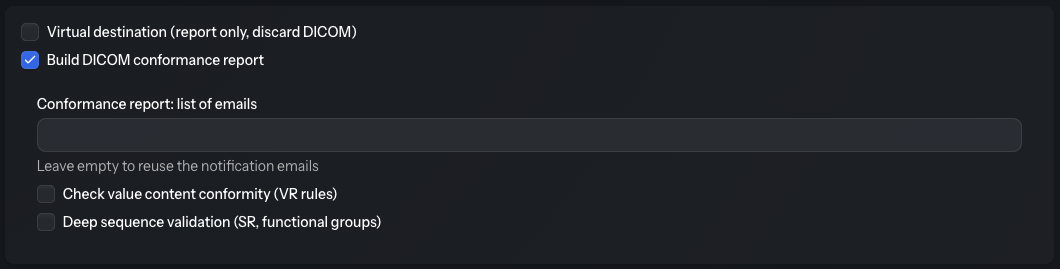
| Setting | Description |
|---|---|
| Build DICOM conformance report | Turns the feature on for the destination. |
| Conformance report: list of emails | Comma-separated recipients. Leave empty to reuse the destination’s notification email list. |
| Check value content conformity (VR rules) | Also report values that violate their VR length or format rules (PS3.5) — e.g. an over-long string or a malformed date. |
| Deep sequence validation (SR, functional groups) | Recurse the checks through every sequence level (e.g. the SR content tree or enhanced multiframe functional groups) instead of only the first one. The recursion is bounded by a defined depth limit (conformance-report.max-sequence-depth, 8 by default). Off by default, as deeper recursion increases memory use. |
| Check for identifying data burned into the image | Run OCR on each forwarded image through the external de-identification image service and list, in the report, which patient-identifying DICOM tag values are still visible in the pixel data. The OCR runs on the image actually sent (after any masking), so it verifies that no identifying text leaves Karnak; to audit the incoming image instead, enable it on a virtual destination. Off by default. Requires the service to be reachable at OCR_URL (default http://localhost:8000); when it is not, the images are reported as not analyzed and the rest of the report is unaffected. |
The report is delivered by email, so Karnak’s outgoing mail server must be configured, as for the destination notifications.
Info
A virtual destination is report-only: it always builds a conformance report — that is its only output — so the report cannot be turned off while the destination is virtual.
When the report is sent
Reports are generated per study. Karnak accumulates the validation results of every instance of a study as they are processed, and emails one report once the study’s transfer goes idle — i.e. no new instance has arrived for that study within the idle timeout (5 minutes by default). A study is also flushed if it exceeds a maximum lifetime (4 hours by default), to guard against studies that never complete, and pending reports are flushed when Karnak shuts down. Studies are grouped per source forward node, destination and Study Instance UID — independently of the DICOM associations used — so a source sending to several destinations gets one report per destination, and instances arriving after a study’s report was sent produce a small follow-up report.
Info
If a study has no recipient email — neither a conformance report list nor a fallback notification list — its report is dropped (and the event is logged). Make sure at least one email address is configured.
These timings are tunable by the administrator with the following settings:
| Setting | Default | Description |
|---|---|---|
conformance-report.idle-timeout-seconds |
300 |
Idle delay after the last instance of a study before the report is sent. |
conformance-report.max-study-lifetime-seconds |
14400 |
Maximum lifetime of a study batch before it is flushed regardless of idleness. |
conformance-report.max-sequence-depth |
8 |
Maximum sequence recursion depth used when Deep sequence validation is enabled. |
How the report is built
Each instance is validated against the IOD of its SOP Class. An Information Object Definition (IOD) is the part of the DICOM standard that specifies, for a given object type (e.g. an MR Image, a CT Image, a Structured Report), which modules and attributes the object must contain and how strict each one is.
The checks use a bundled, machine-readable copy of the DICOM standard extracted by the
Innolitics dicom-standard project
(the list of SOP Classes, their modules, and every attribute with its VR, value
multiplicity and Type), complemented by a curated rule set maintained in Karnak for the
parts the standard only expresses as prose (enumerated values and a subset of
machine-evaluable conditions).
IOD structure (modules, tags, VR, Type)
For the instance’s SOP Class, Karnak resolves the applicable modules and checks:
- Module presence — a mandatory (usage M) module whose required attributes are all absent is reported as missing.
- Attribute Type — each attribute’s requirement is enforced:
- Type 1 — must be present and carry a value (present-but-empty is an error).
- Type 2 — must be present, but may be empty.
- Type 3 — optional.
- VR (Value Representation) — the encoded VR must match the one the standard defines for the attribute.
- VM (Value Multiplicity) — the number of values must fall within the range the standard allows.
Conditional requirements (Type 1C / 2C)
Some attributes are conditionally required (Type 1C / 2C, or attributes inside a usage-C module) — mandatory only when a condition holds (for example, “required if the image is a localizer”). Karnak evaluates these when possible: when a curated, machine-evaluable condition resolves to true for the instance, the attribute is treated as mandatory (1C is checked like Type 1, 2C like Type 2).
Info
Limitation. In the standard, these conditions are free text and many are clinical in nature, so they cannot all be evaluated automatically. When a condition has no curated machine-evaluable rule — or it evaluates to false/unknown — the attribute is only validated if it is actually present; its conditional requirement is not enforced. Karnak therefore never raises a false conformance error on a condition it cannot reliably evaluate.
Private tags
Private data elements are checked for block structure only (PS3.5 §7.8): every private data element must belong to a block reserved by a non-empty Private Creator element. A private element with no reserving creator, or an empty Private Creator, is reported.
Info
Limitation. Private values are not interpreted or validated — Karnak does not carry vendor-specific private dictionaries, so only the standard-defined block structure is verified.
Other checks
Beyond the IOD structure, Karnak runs a set of value-level and cross-attribute checks
modeled on those of David Clunie’s dciodvfy
verifier. The table lists what each one verifies and the severity it raises; a few are
optional (value-conformity option) or deep (deep-sequence option), as noted.
| Check | What it verifies | Severity |
|---|---|---|
| Enumerated values / Defined Terms | Value lies within a closed Enumerated Values set; an unexpected Defined Term is a softer signal. | Error / Warning |
| Plausible values | No value of zero where it is physically impossible — structural counts & geometry vs. acquisition/physics parameters¹ — and no negative Spacing Between Slices (Nuclear Medicine excepted). | Error / Warning |
| Pixel geometry | Pixel Aspect Ratio of 1:1 is omitted; Pixel Spacing matches Imager / Nominal Scanned Pixel Spacing unless a Pixel Spacing Calibration Type explains the difference. | Error / Warning |
| Image & patient orientation | Image Orientation (Patient) is two unit, orthogonal direction-cosine vectors; Patient Orientation uses valid biped codes, with no opposing directions in one value and distinct row/column directions. | Error |
| Laterality | A paired (non-midline) Body Part Examined carries a Laterality, unless one is already conveyed or the object type makes it inapplicable. | Warning |
| Coded entries | A Code Value uses only the characters its Coding Scheme Designator allows (SNOMED / DICOM) and does not denote the “Unknown” concept. | Warning |
| Identifier reuse | The SOP Instance, Series, Study and Frame of Reference UIDs all differ from one another. | Error |
| Residual identifiers | No direct identifier remains after de-identification (telephone, address, other names, institution / physician names, occupation, comments…).² | Warning |
| Standard Extended SOP Class | A standard attribute present but not part of the object’s IOD. | Info |
| Retired constructs | Attributes (Info), SOP Classes or transfer syntaxes (Warning) retired in the current standard. | Info / Warning |
| Value content conformity (optional) | String values obey their VR length and format rules (PS3.5 §6.2). | Error / Warning |
| Enhanced multi-frame & segmentation | Per-frame Functional Groups item count equals Number of Frames; Segment Numbers increase monotonically from one (LABELMAP excepted). (deep) Dimension Index Values match the Dimension Index Sequence, and no functional group appears in both the Shared and a Per-frame group. | Error |
| Study-level consistency | Across the closed study: one Study Instance UID, one Patient ID & Name, consistent Frame of Reference, and Modality ↔ SOP Class coherence. | Error / Warning |
Info
¹ Zero is an error for structural counts and geometry (Rows, Columns, Bits Allocated/Stored, Samples per Pixel, Number of Frames, Pixel/Imager Spacing, Slice Thickness, Rescale Slope) and a warning for acquisition/physics parameters where it is merely implausible (KVP, X-Ray Tube Current, Exposure, source distances, Echo/Repetition Time, Magnetic Field Strength, Flip Angle, Patient Weight/Size…).
² The residual-identifier check is specific to the de-identification use case (it goes
beyond dciodvfy); its attribute list mirrors the identifiers removed by dciodvfy’s
companion de-identifier, dcanon, and it is most useful on a de-identifying destination.
Scope notes
- VR is not checked for Implicit VR Little Endian datasets, where the VR comes from the dictionary (the check would be circular).
- By default only the top level and the first sequence level are validated; enabling
Deep sequence validation walks deeper, bounded by the
conformance-report.max-sequence-depthlimit. Two enhanced multi-frame checks (Dimension Index Values count, and a functional group present in both the Shared and a Per-frame group) require this option, because they read per-frame functional groups. - Deep validation checks the encoding and the structural rules of nested attributes; it does not verify SR-specific semantics (template/TID conformance, content-item value-type rules, parent/child relationships) or whole-slide tile relationships.
- SOP Classes the bundled standard does not define (unknown or retired) are flagged, and their IOD module checks are skipped.
What the report contains
The HTML email summarizes, for the study:
- Study and patient context — patient ID and name, study date, description and accession number, source AE Title, and whether the data was de-identified.
- Counts — number of series, instances, and failed instances, plus the totals of errors, warnings and informational findings, and an overall pass/fail.
- Composition — the modalities, SOP Class UIDs and transfer syntaxes encountered.
- Per-series summary — each series with its modality, SOP classes and instance count.
- Findings — conformance findings grouped by SOP class (with an example instance and a count), and study-level consistency findings for attributes that should be identical across the study but are not.
- Identifying data on image — only when Check for identifying data burned into the image is enabled: the patient-identifying tags whose value was found burned into the pixel data, with the number of images affected; otherwise how many images were analyzed, or could not be analyzed because the de-identification image service was unreachable.
Examples
The reports below are real, de-identified examples — three studies that fail conformance and one that passes — that illustrate the kinds of findings the validator produces. Each opens in a new tab as the actual HTML email.
Info
In every example the patient name shows as (hidden — destination not de-identified). The report only redacts the name when the destination’s data is not de-identified, to avoid emailing identifying information in clear text; the patient ID and other attributes are still shown.
Example 1 — missing module, pixel geometry and private-block issues
Ultrasound study · 6 series · 6 instances · FAILED — 3 errors, 6 warnings, 4 info
A multi-frame ultrasound study that trips several unrelated rules at once. The errors are a missing mandatory module (the required Cine attributes are all absent) and two pixel-geometry violations (a Pixel Aspect Ratio of 1:1 is encoded when the standard says to omit it). The warnings cover three private blocks used without a Private Creator, a missing Type 2 Image Type, a retired SOP Class, and a mis-formatted date; the informational findings flag retired and non-standard (standard-extended) attributes. A spread like this usually reflects the acquisition device’s encoding conventions.
Example 2 — a passing study
Computed Radiography (CR) study · 1 series · 1 instance · PASSED — 0 errors, 8 warnings, 17 info
This is what a study that meets the standard looks like: with no errors the overall result is
PASSED, even though the report still lists warnings and informational findings. The warnings
are implausible zero values — physics parameters such as KVP, Exposure and Patient’s
Weight recorded as 0 — and a missing Laterality on a paired body part; none of these
breaks the standard, so none fails the study. The informational findings are mostly
standard-extended attributes (present but not part of this object’s IOD) plus one retired
attribute. A “passed with warnings and info” result like this is normal and usually needs no
action, though the warnings can be worth a look.
Example 3 — empty Type 1/1C, a VM violation and UID-format problems
Digital X-Ray (DX) study · 1 series · 1 instance · FAILED — 7 errors, 4 warnings, 1 info
A good illustration that a single instance can surface several unrelated rule categories at once. The errors span presence (a missing mandatory module and four Type 1 / 1C attributes present but empty), value multiplicity (Patient Orientation carrying the wrong number of values) and an image-orientation rule. The warnings add a missing recommended attribute and three UID-format problems (identifiers that don’t follow the DICOM UID syntax). When one object trips this many distinct rules, the cause is usually upstream encoding rather than the individual values.
Example 4 — missing Type 1 attributes inside SR sequences
SR + CR study · 2 series · 2 instances · FAILED — 16 errors, 4 warnings, 3 info
A mixed-modality study — a Basic Text Structured Report sent alongside a Computed Radiography image — whose SR is missing many mandatory elements. Fifteen of the sixteen errors are Type 1 attributes missing inside the SR content sequences (Graphic Data, Concept Code Sequence, Temporal Range Type…); the remaining error is an empty Type 1 LUT Data in the CR image. The warnings note two missing Type 2 attributes, a value-format issue and a missing Laterality, and the informational findings list retired and non-standard attributes. A deeply incomplete SR like this points to the application that generated it.
Relation to other DICOM validators
Karnak’s conformance report is not meant to replace the established standalone validators — it serves a different purpose. It validates automatically, inside the forwarding pipeline, and per study, so conformance is checked continuously without a separate tool or manual step. Because it sees the whole study batch, it can also run cross-instance consistency checks (single Study Instance UID, consistent Patient ID / Name, Modality ↔ SOP Class coherence, Frame of Reference) that single-file tools cannot.
For the per-object checks, Karnak builds on the same approach as the
pydicom/dicom-validator: both derive the IOD
requirements from a machine-readable copy of the DICOM standard (Karnak uses the
Innolitics dicom-standard extraction) and
both evaluate conditional (Type 1C/2C) requirements only when the condition can be
evaluated, treating them as optional otherwise — so neither raises false errors on
clinical, free-text conditions.
For the value-level and cross-attribute checks, Karnak additionally mirrors a
substantial subset of dciodvfy: zero/
implausible values, pixel and image geometry, patient orientation, laterality, coded-entry
validity, UID reuse and enhanced multi-frame / segmentation consistency (see
Other checks). dciodvfy nonetheless remains the more exhaustive
single-object reference — notably for byte-level encoding and full SR content-tree
semantics, which Karnak does not attempt.
For an exhaustive, authoritative check of an individual object, or for interactive/standalone validation, the well-known dedicated tools remain the reference and complement Karnak well:
- dciodvfy (David Clunie’s dicom3tools) — the long-standing reference single-object validator, with the most thorough encoding and value-level checks.
- dcm4che
dcmvalidate— validates against a supplied XML IOD definition. - DVTk — a toolkit that validates against editable DICOM definition files.
- IHE Gazelle — the IHE testing platform, whose validation services can run several DICOM validators so their results can be compared.